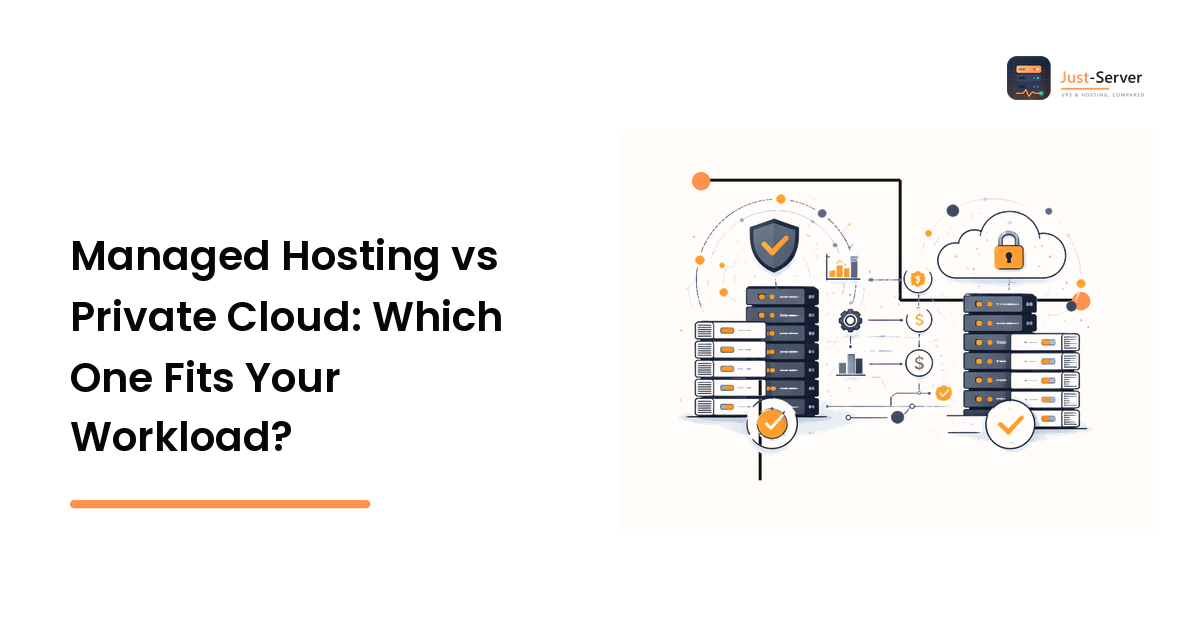
Managed hosting is a provider-administered server or plan where someone else runs the stack; private cloud is a pool of virtualised compute reserved for one tenant, which you carve into machines yourself. Choose managed hosting when you want fewer operational duties. Choose private cloud when you need elastic capacity, isolation, and control over how resources are divided.
Both sit above a single VPS and both get sold with the same words — "dedicated resources", "enterprise-grade", "fully supported". The difference that matters is not the marketing tier. It is who divides the resources and who does the operational work.
If you haven't settled on a hosting tier at all yet, start with our breakdown of the main hosting types; this article assumes you have outgrown a single shared plan.
What is managed hosting, precisely?
Managed hosting means the provider owns the administration of the environment your site or app runs on. That environment might be a shared platform, a VPS, or a whole dedicated machine — "managed" describes the support model, not the hardware.
On a genuine managed plan the provider handles:
- OS and stack maintenance — kernel and package updates, web server, PHP or runtime versions, database tuning.
- Security at the platform layer — firewall rules, intrusion prevention, TLS certificate issuance and renewal (commonly via an ACME certificate authority such as Let's Encrypt).
- Backups on a defined schedule with a stated retention window and a restore path.
- Monitoring and incident response — someone is paged when the box stops answering, not just you.
What you keep is your application: your code, your dependencies, your content. You give up root-level freedom in exchange for not being the person who patches a CVE at 2am — the same logic behind the WordPress-specific version of this decision, covered in managed WordPress hosting explained.
The catch is that "managed" has no standard definition. Some plans manage the entire stack up to your application; others manage the hardware and consider the OS your problem. Always get the responsibility boundary in writing before comparing prices.
What is private cloud, precisely?
A private cloud is cloud infrastructure — virtualised compute, storage, and networking with an API or control panel in front of it — where the underlying physical capacity is reserved for a single tenant. Nobody else's workloads run on your hypervisors.
Practically, you get a pool of resources (say 64 vCPU and 256 GB of RAM across a few physical hosts) and you decide how to slice it: eight medium VMs today, twenty small ones next month, all without ordering new hardware. You typically also get:
- A hypervisor layer you control — VMware, Proxmox, KVM, or similar, exposing snapshots, live migration between hosts, and templating.
- Private networking — VLANs or virtual switches between your machines, so app servers talk to databases without crossing the public internet.
- Redundancy across hosts — if one physical node fails, the hypervisor can restart its VMs on another node in the pool.
Two things are commonly misunderstood. Private cloud is not automatically more secure than public cloud; it is more isolated, and isolation only helps if you configure the rest correctly. And it is not inherently managed — most offerings hand you the console and stop there.
How do the two compare on the things that actually cost you?
| Dimension | Managed hosting | Private cloud |
|---|---|---|
| Resource allocation | Provider sets it; you pick a plan tier | You divide a reserved pool into VMs as you like |
| Tenancy | Shared platform or a single dedicated machine | Single-tenant across the whole hardware pool |
| Who does the ops work | Provider (to a contracted boundary) | You, unless you buy managed private cloud |
| Root / hypervisor access | Limited or none | Full, including the virtualisation layer |
| Scaling model | Upgrade to a bigger plan; usually a migration | Provision new VMs from spare pool capacity in minutes |
| Time to add capacity | Hours to days, provider-dependent | Minutes within the pool; new hardware takes longer |
| Cost shape | Predictable monthly fee per plan | Larger committed baseline; marginal VMs are cheap |
| Skills needed | Application-level only | Linux, networking, virtualisation, backup design |
| Redundancy | Depends entirely on the plan | Host-level failover if the pool is built for it |
| Best fit | One workload, small team, no sysadmin | Many workloads, in-house ops capability |
The row that decides most cases is skills needed. Private cloud only pays off if someone on your side can design the network, size the VMs, and own the backup strategy. Without that, you have bought flexibility you cannot spend.
When is managed hosting the better call?
Pick managed hosting when your workload is singular and your team is small. Concretely:
- You run one significant site or app, not a fleet.
- Nobody on the team wants to be on call for infrastructure.
- Your traffic is predictable enough that a plan tier fits it.
- Compliance or client contracts require a named party responsible for patching — and you would rather that be the provider.
Agencies hosting a handful of client sites usually belong here too. The support contract absorbs maintenance that would otherwise land unbilled on whoever knows Linux best.
Before upgrading a tier because things feel slow, confirm resources are genuinely the constraint. Our guide on sizing a VPS covers measuring real CPU, memory, and I/O usage — much of "we need a bigger server" turns out to be an unoptimised query or missing cache, and performance and uptime work is far cheaper than a tier jump.
When is private cloud the better call?
Pick private cloud when you have several workloads and the internal capability to run them. The signals:
- You run many machines. Once you are paying for six or more separate servers, consolidating them onto a reserved pool is usually cheaper per unit of compute and much faster to change.
- Your capacity needs move. Seasonal spikes, per-client environments, staging copies that appear and disappear — carving VMs from spare pool capacity beats ordering new servers each time.
- You need isolation you can prove. Single-tenant hardware answers a specific class of customer questionnaire that shared platforms cannot.
- You want an internal network between services. Private VLANs between app, cache, and database tiers remove a whole category of exposure.
- You have ops capacity. Someone owns patching, monitoring, and restores — because on unmanaged private cloud, all of that is yours.
That last point deserves weight. Hypervisor snapshots are not backups: they live on the same infrastructure as the thing they protect. Whatever tier you land on, pair it with a real 3-2-1 backup strategy with at least one copy off the platform.
The verdict
For most teams below roughly half a dozen servers, managed hosting wins — not because it is technically superior, but because the ops work it removes is worth more than the flexibility it withholds. The failure mode of managed hosting is a ceiling. The failure mode of an under-staffed private cloud is an unpatched estate, and that is the more expensive mistake.
Move to private cloud when three things are true at once: you are running enough machines that consolidation is cheaper, your capacity needs change faster than a provisioning cycle, and you have someone whose job includes the infrastructure. If only two hold, buy managed private cloud instead — it costs more per month and less in incidents.
And if you are weighing these two while still running comfortably on one box, you are early. A well-sized VPS with real backups and monitoring carries more load than most people expect.
FAQ
Is private cloud more secure than managed hosting? It is more isolated, which is not the same thing. Single-tenant hardware removes noisy-neighbour and hypervisor-escape risk classes, but the vast majority of real breaches come from unpatched software, weak credentials, and exposed services. A well-maintained managed plan is usually safer than a neglected private cloud.
Can I get a managed private cloud? Yes — most providers who sell private cloud also sell a managed wrapper for it. You get the isolation and flexibility of a reserved pool plus a support contract covering the hypervisor and guest operating systems. Confirm exactly which layers the contract covers; "managed" often stops at the hypervisor and leaves your VMs to you.
Is private cloud the same as a dedicated server? No. A dedicated server is one physical machine you rent. A private cloud is a pool of machines running a virtualisation layer you control, so you can create, resize, and move VMs across them. A single dedicated server has no host-level failover; a properly built pool does.
Does private cloud scale like public cloud? Only within the capacity you have reserved. Spinning up a new VM from spare pool resources takes minutes, but expanding the pool itself means the provider adding hardware — days or weeks. Public cloud's near-instant elasticity is the trade you accept for single-tenancy and a predictable bill.
How do I know when I've outgrown managed hosting? Watch for three signals: you are regularly blocked by something you cannot configure, you are paying for several separate managed plans that would be cheaper consolidated, or your provider's upgrade path has run out of tiers. Any one of those is a reason to price the next step.
Ready to price the next tier? Compare managed plans and private cloud options side by side before you commit to an annual contract.